Friday, February 9, 2018

WE HAVE MOVED

Coupled with the launch of my new website www.horizoncx.com all historical blogs and any blogs from this point onward can be found here at https://horizoncx.com/cx-blog/


Sunday, December 24, 2017

The Corporate CX 7-Year Itch

This is my end-of-year blog for 2017 and, for those that follow me, this blog page will morph into a blog page on my new website that should be going live in January.

In his 2017 end-of-year reflective blog, CX Consultant and colleague Ian Golding wrote about The Customer Experience 7-Year Itch in which he describes the state of the Customer Experience Profession as we approach 2018 and concludes that it’s akin to the marital equivalent of ‘the 7-year itch’ and in seven years since the profession was formally created, with a few notable exceptions, not a great deal has changed for the customer or for the employee—a point to which I completely agree. 

I’ll extend that concept to the organizations that employ the CX professional. There seems to be another 7-year itch at play in the corporate world where organizations that started down that CX path seven years ago have either hit or are approaching that critical 7-year point.  I call this the Corporate CX 7-year itch. This is the point where the initial rise and enthusiasm around CX among leadership peaks and begins to diminish.  More and more questions begin to surface as to what they are getting in return for the investment and in some cases question arise as to why continue to collect voice-of-the-customer particularly when they feel that their customers are happy enough based on the scores they are providing.  Considering added financial pressures to cut costs, they feel they don't need to keep investing as much in CX any longer. 

Some of that could be code for "annual bonus preservation” and this is one way they perceive achieve that.  I left one large public organization after 10 years and ahead of that wave, but the itch started around year seven.  I'm currently working with another organization now where CX just hit the eight-year mark and guess what?  Yes indeed, the itch is well underway there as well.  My sample size may be small here, but I believe I might have identified a new and unique CX 7-year itch.  It’s up to us CX professionals to help relieve the Corporate CX 7-year itch. 

Scientists have found that the reason scratching an itch offers relief is because scratching causes pain, which suppresses the itch.  Now there’s something many corporate leaders can readily identify with - pain points, and the elimination thereof.  It's highly tactical where they don't have to think too much and it’s relatively easy and inexpensive to administer. 

The objective would then be to proactively identify (or perhaps even create) some pain points within the organization where CX serves as the remedy - scratching the itch as it were before it happens. I don't have a readily available example of how this might work in a real corporate situation but this is where creativity come into play.  I could imagine this idea working a lot more easily coming from a CX consultant as I find they are taken a bit more seriously than internal CX resources who have a position and job-security to protect and preserve. 


CX professionals need to ensure that the right approaches, techniques and tools are made available to ensure CX is delivered profitably.  Careful and effective identification of pain-points that are creating customer discontent and potentially limiting revenues and profitability, done right, should start to relieve or prevent that itch.  Perhaps readers working within an organization might have an example of that to share. Feel free to add commentary.

Friday, November 3, 2017

How to Make Communication More Efficient in the Workplace

This guest blog written by Rae Steinbach was submitted to me by David Mizne, chief contributor and editor of the award winning 15Five Blog. Rae is a graduate of Tufts University with a combined International Relations and Chinese degree. After spending time living and working abroad in China, she returned to NYC to pursue her career and continue curating quality content. Rae is passionate about travel, food, and writing, of course.


Remember when Ford and Bridgestone Firestone lost billions due to a truly avoidable error? The team designing the Ford Explorer didn’t coordinate with the team responsible for the tire design. This resulted in safety issues that forced a recall.

Unfortunately, these types of errors are fairly common. This is especially true in companies that lack organization. Different teams and departments must communicate with one another clearly and regularly in order to avoid making such mistakes. When you prioritize communication, you ensure that everyone is on the same page. The following tips will help:

Accept Feedback

Communication should never be a one-way street, but unless employees know they can (and should) offer their own feedback, it’s unlikely they’ll be eager to share their thoughts.

Employee feedback can be vital in order to show both staff appreciation and to provide constructive criticism.  By encouraging your workers to share their opinions, you’ll boost their overall willingness to communicate.

Establish a Set of Goals and Values

One of the best ways to improve inter-department coordination is, ironically, by focusing on your broader vision for the company at first, instead of the small details. Try to establish a mission statement that’s no more than three sentences long. Once you’ve finalized it, post it regularly in places your employees will see it, like emails, bulletin boards, and marketing materials. It’s easier to improve communication when all team members are united by a common goal.

Train Your Employees Thoroughly

It’s tempting to put new employees to work right away. In the long run it’s better to put your employees through a training program when they first join the company. This streamlines the communication process in the future because they’ll know who they should stay in touch with while working on a project.

Make Sure Key Information is Available to Everyone

When you’re working on a project, you may not have time to provide the supervisors of every other relevant department with constant updates. Instead, create a company wiki or FAQ page where you can post vital info that members of other departments may need. This resource will help prevent miscommunications.

Seek Out Fun Environments

Most employees are more willing to communicate when their guard is down. That’s why it’s often a good idea to hold unofficial “meetings” outside of the office. Bringing your team out to lunch for a few hours will make them more relaxed, and thus more willing to be communicative. Make these outings a regular occurrence throughout the lifespan of a project.  Don’t let lack of communication result in an error that will cost your company money and productivity. Keep these tips in mind, and use them to establish clear and efficient lines of communication throughout the organization.

Wednesday, November 2, 2016

The Uphill Challenges of CX

On the cover of the November 2016 issue of Harvard Business Review (HBR) in pink uppercase lettering is the headline “WHAT KEEPS CEOs UP AT NIGHT.”  Just below that are the words “Brand building, executive pay, and managing Millennials—for starters.”  My finely attuned CX radar kicks in here and I notice that the word “customer” is missing. Not surprisingly though, upon reading the article, I see that executive pay is among the top concerns of CEOs.  With that as my backdrop, I began reflecting upon my role as a Customer Experience (CX) professional over the past 14 years — not to mention my 37 years in direct customer-facing roles.
After speaking with many of my counterparts across various industries, I’m continually perplexed by the struggle that we all seem to have to drive the customer agenda to the center of importance within broader business strategy. It doesn’t help that the CEO position is often a revolving door. According to the HBR article mentioned above, in 2015, turnover among global CEOs reached a record rate of nearly 17% and more than one fifth were dismissed—reportedly for failing to resist the lure of short-termism. 
As CX professionals, we have all come to terms with the fact that CEO engagement and commitment in the form of demonstrated action is an essential requirement toward making CX a strategic imperative and competitive differentiator within any business.  Given a 17% CEO turnover rate, it’s no wonder that, even in situations where the CEO was committed and actively involved in CX, a transition to a new CEO doesn’t come automatically loaded with a customer centric mind-set.  Therefore, whatever CX progress and success had been built up during that previous CEO’s tenure could in fact disappear rather quickly depending on the mind-set of the incoming CEO.
And so it goes that as a CX professional we all seem to struggle to varying degrees rolling that CX boulder up the hill.  Considering what I have described, the challenges we face are partly out of our control.  We can work diligently to advance the CX practice and build a solid business case for CX but then a change in leadership comes about and we are back at maybe square three or two (but hopefully never square one!).  In some organizations that kind of transition can take CX entirely out of the strategic picture while in others it’s more a matter of restarting some parts of the CX journey all over again.  That’s where the resiliency and determination of a CX professional is required — but only if the organization has the vision and the customer-centric mind-set and is not swayed by another round of short-termism.

CX is not easy and CX is a long-term strategy.  Those in CX roles know all too well, just as I have experienced, that after five, seven or even ten years into the journey, and with many hurdles overcome and many accomplishments to show, we can still feel as if we are just at the beginning of the CX transformation.  We continually push that boulder while simultaneously attempting to alter the landscape so that the push becomes just a nudge as we strive for the day that the boulder starts rolling with its own momentum while we guide it along the success path. Progress may be slower than we’d like it to be, but I feel the secret lies within our ability to educate and influence key stakeholders within the business.  And if we find ourselves at an impasse due to factors beyond our control, then to recognize that and recognize that it’s time to move on.  Look within your own organization to see where the commitment to CX is strongest and leverage that energy to your advantage.  The bottom line however is that without a committed leadership team, the grade will be uphill and steep and the boulder will move very slowly, if at all.  Just watch that it doesn’t start rolling back in your direction.

Tuesday, September 15, 2015

The Power of a Bonded Organizational Culture

With onset of fall here in the Northeast US, I find the changing seasons to be a time of inspiration and reflection.  Last evening I attended a lecture in our local library.  Grant Welker, co-author of the recently published book, We Are Market Basket, gave a small turnout of about 20 people a 30 minute synopsis of an unusual event that happened here in the Northeast a year ago and occupied the news wires daily for over two months—a local family owned supermarket chain, Market Basket, was literally brought to its knees and to the brink of bankruptcy by a strong coalition of employees, customer, and suppliers—a bonded organizational culture.

The firing of Market Basket CEO Arthur T. Demoulas in the midst of a long-term family feud catalyzed a management and rank-and-file employee walkout the likes of which have not been witnessed in decades.  The protest of the firing of the president and chief executive, Artie T. as he is commonly known, by a vindictive board controlled by his first cousin, Arthur S. Demoulas, and other rival family members started a chain reaction that effectively immobilized the business in just a matter of six short weeks—along with a 90% loss in sales revenues.  Suppliers also join the mini-revolution, refusing to deliver groceries and goods that left store shelves completely empty.  Some employees still worked during the walkout, but with nothing for customer to buy, many stored simply closed their doors leaving customer to go elsewhere.

How could such an employee rebellion have happened so quickly and so effectively within a non-unionized business?  The walkout severed the company’s supply chain and left its store shelves empty throughout the community for weeks as the Demoulas family struggled to resolve its 25-year feud over the management of the company.  How could so many managers and employees have put their jobs on the line and risked having their income severed for weeks all in the name of reinstating their beloved leader, Artie T?

The answer of course lies deeply within the culture of this nearly 100 year old business started by a Greek immigrant in 1917 in the city of Lowell Massachusetts.  A strong focus on employees and customers alike that began almost 100 years ago was sustained and nurtured over the generations by the Demoulas family and in particular Artie T himself.  Here’s a snippet of that culture to give you an idea.

Employees and even customers are treated like family.  Artie T. regularly visits every one of the 70 stores in the region—being visible, talking to employees and customers and often remembering their names and more. Market Basket is a $4B, 20,000 employee company just to give you a perspective here.  When you walk into a Market Basket, you’ll immediately see they are different than any of the other local supermarkets.  There are no self-checkouts—they want maintain frequent employee to customer interactions.  Managers wear shirts and ties.  Shelves are stocked during the day so employees can interact with customers, answering their questions, walking them to the right aisle and location so they can find their desired item.   There are no loyalty cards—the same pricing advantages are offered to all customers.  Their pricing is the lowest in the industry—enabled by a decided focus on function over form.  Profits are shared with all employees and they are among the more highly paid among the local supermarket industry.  There’s a lot more to know and it’s all in the book.

Upon the firing of the CEO, certain store managers that protested were promptly fired.  That started the ball rolling and many employees soon followed them out the door.  The solidarity and resolve among managers, employees, customer, and suppliers was unprecedented—return our CEO or we’ll bring this organization down—and that’s exactly what they did.  In the end, the employees, customer, suppliers—the bonded culture and community solidarity won out.  The board had no choice but to offer the company and the CEO position back to Arthur T. Demoulas.  Market Basket reopened, employees went back to work, suppliers delivered the goods and 90% percent of their loyal customers returned—along with many more new customers who had to visit a Market Basket if for no other reason than out of curiosity.  Today they are a thriving $4.5B company and opening new supermarkets across the region.

The interesting question to ask yourself here is this.  If the CEO of your company were to be unfairly dismissed, as Arthur T. apparently was, how likely would you be to risk your own position and continuous cash flow unless that individual was reinstated?  As a side note, the family infighting was something that had been going on for years and the reason Artie T. was fired by the board was that they wanted to divert the profits mainly to the shareholders, manage the company differently and in the process cut costs and people that would have led Market Basket down the road of mediocrity and being “just like all the other supermarkets.” Employees and customers saw that vision as a threat to what they had come to know and love—their leader, the people, the relationships, and the community they had built over 100 years. This is truly an example of an unwavering and a bonded culture.

I was fortunate enough to have worked for a company from 1984 to 1994 that had such a bonded culture—Zymark Corporation—at that time, a privately held venture capital funded company that began with the premise that culture came first.  It was a community that held employees in the highest regard and where customers ran a close second.  Stakeholders may have come last in that sequence but let’s be totally real and honest here—when you take care of your employees they’re more likely to super-serve customers and remain loyal to the organization.  That in-turn will generate repeat business, highly satisfied customers with a greater sense of loyalty, many of whom will serve as references for additional business.  Stakeholders will naturally reap the rewards of that model and that’s a model where everyone stands to win.  

I think back to that time in my career and I ask myself whether I would have risked my job and salary if our CEO had been unfairly terminated.  I truly believe that I, and many of my colleagues, would have acted exactly the same as those at Market Basket did.  I do wonder however how likely it is that this kind of event would ever occur again.   I welcome your responses to this along with any and stories you may have to share of experiences working within a bonded organizational culture.

Monday, July 13, 2015

The Discount-Revenge Cycle - and how to be a better communicator

Customer Experience encompasses a multitude of sub-disciplines and covers substantial ground in the world of business.   However, one specific aspect of Customer Experience that interests me in particular and is something I’ve been attuned to for years is the art of communication.   Those working within an organization where there is more than one employee, which naturally applies to just about everyone except for those one-person operations, will appreciate the ideas expressed here. Even those running solo independent businesses will also appreciate the opportunity this presents to them in terms of honest self-reflection.

During my time at Boston University where I was studying adult learning theory and instructional design, a professor introduced me to the work of George M. Prince who was the co-creator Synectics.  Synectics is a creative problem-solving process as well as the name of the company co-founded by George Prince.  The process of creativity was so interesting to me that I took a summer course with George and got to know him personally and thereafter invited him to bring some of his ideas around communication into the organization I was working for at the time.  It proved both educational yet surprisingly disrupting to the 20 or so employees that were invited to take part in a Synectics creativity session.

Sessions were recorded and what was discovered is that certain things will reduce the probability of a successful outcome, and the language we use to communicate is one of the more significant.  A discovery of this led to what is known as the Discount-Revenge cycle.  This is a relatively invisible yet dynamic process that has a great influence on people working together for a common purpose.  Essentially it goes something like this.

In a group setting at work with the common goal of coming up with some new ideas that will solve a customer experience problem, George hands a dry erase marker to Susan and says “Here, Susan why don’t you take notes so we can capture everything.”  Ideas start out slowly but eventually start getting generated and Bill enthusiastically jumps up and says “I think we should run a lost-business study to see why some customers are choosing to leave us” and then Mary chimes in very quickly and says “That’s too slow and isn’t going to help us get to the root cause very quickly.”  The conversation continues as suggestions are made yet Bill is noticeably quiet until Mary suggests “Maybe we should add a question to our relationship survey to see how likely a customer is to do repeat business with us.”  Bill jumps right back with “But we already ask them how likely they are to recommend us and if they are aren’t then they sure as heck aren’t likely to but from us again if that’s the case.”  Susan has been noticeably quiet in her role as scribe and has offered no suggestions at all during the meeting.

What we see happening here is a classic example of the discount-revenge cycle.  This is precisely what George Prince and his colleagues studied and were able to prove through repeated recording of sessions like this and from brain research which is that people are extremely sensitive to the slightest threat to meaningfulness.  Anything that is perceived as a discount will tend to generate a response in the form of either revenge (a come-back, or one-better) or a complete withdrawal. 

In this example, Bill perceives Mary’s response to his suggestion as a discount of his idea and awaits his chance for revenge by further discounting Mary’s later suggestion.  The two of them appear to have an inclination to keep the discount-revenge cycle going whereas Susan just quietly withdrew from participation in the dialog entirely after having been asked to be the scribe—something she likely perceived as a discount, albeit a slight one. 

According to the work of George Prince, any sort of slight or negative attention or lack of acknowledgment is enough to set the discount-revenge cycle in motion. Given the unlimited opportunities for such unintended discounts in the everyday operations of businesses and other organizations, the extent of defensiveness and lack of commitment by employees is hardly surprising.
What can we do individually help foster better communication in situations like the one described above?  Here are four fairly simple ground rules or best-practices—one’s that should be discussed and agreed to at the start of any meeting where problem solving and or creativity are required.

  1. All ideas need to be acknowledged and people need to feel validated.  Acknowledgment does not necessarily mean you agree with an idea. Until proper dialog and discussion has taken place, all ideas should remain on the table. No idea should ever be rejected out of hand, because to do so discounts the individual that offered it and starts the cycle of discount-revenge.
  2. Avoid using the word “but.”   But, literally negates what someone has just said or offered. “But we tried that before and it didn’t work,” is such a classic response that is sure to generate revenge or withdrawal by others.  Try saying “Yes, that’s something we did try before with little result, but maybe we can approach it differently this time.”  See the difference?  In the latter you are acknowledging the idea and validating the individual and leaving the door open to new options and ideas to actually make something work.
  3. Take ownership.  Avoid accusatory language that typically starts with the word “you.” A professor friend of mine recently told me that his graduate student said to him “You dinged me on my grade.”  This of course discounted the professor, made him feel like the perpetrator that did something unfair to the student.  Nothing could have been further from the truth.  In reality the student actually reduced his own grade himself by not completing a specific assignment on time and by not participating in class. 
  4. With any suggestion or idea, start by coming up with three positive reasons why it might be OK or a good idea.  Trust me, this can be a 100% effective practice.  Forcing out three good aspects to any idea is sure to create enthusiasm and perhaps even a bit of levity.  After that, instead of just coming up with three negative aspects of the idea, couch them in terms of problems that, if overcome, could help make that idea a viable idea or solution.  Now you’re using language that’s constructive and relationship-building instead of destructive and damaging to relationships. 
For more about the work of George Prince and the creative problem-solving process, consider among the following books he wrote on the subject.


·         The Practice of Creativity, George M. Prince, 1970, New York: 
Collier Books, Div. of Macmillan Publishing, Co. Inc.


·         Your Life is a Series of Meetings – Get a Good Life, George M. Prince with Kathleen Logan-Prince, 2002
1st Books Library, www.1stbooks.com

Monday, December 29, 2014

The CX Chronicle (TM): Empathy Leads - Customer Experience Follows

The CX Chronicle (TM): Empathy Leads - Customer Experience Follows: For my final blog of 2014 I’ve decided to address, empathy, a fundamental essence of Customer Experience, by reflecting on the year behind ...

Empathy Leads - Customer Experience Follows

For my final blog of 2014 I’ve decided to address, empathy, a fundamental essence of Customer Experience, by reflecting on the year behind me with no regrets and foreseeing the year in front of me with great optimism.  It’s rewarding every now and then to take stock of one’s entire career and how it has evolved.  I spent four years in the US Air Force, returned to work in the science arena, earned a degree in Chemistry and enjoyed several years as an analytical chemist, entering marketing and working with customers and publishing and speaking at conferences, getting into the field of laboratory automation and robotics and selling systems, managing training and teaching clients programming skills, becoming a training road-warrior for several years before landing in the role of Customer Experience Manager.

That last role of Customer Experience Manager is significant for me because it’s the profession I believe I was destined to be in and working toward along my entire career path.  It just took a lot of stepping stones for me to get there.  So now that I’m finally here, I want to share my thoughts about what I believe it means to be customer centric.  The old well-worn, often misused, and mostly misinterpreted term; “charity begins at home” I feel sums up the true meaning, intent, and starting point of customer-centricity—charity being characterized as a state of mind, a mentality of kindness, and benevolence.

As consumers we are on the receiving end of customer-centricity daily and we are also on the giving end as we serve others in both our work-life and in our private lives—the dual nature of customer-centricity. How we act and react to every aspect of life has an obvious effect on us and on others.  As a Training Instructor, for example, I always felt that I learned as much from students as they hopefully learned from me.  When I attend a lecture or any kind of training session, I feel I learn as much, if not more, about teaching techniques as I do from the subject matter itself—yin and yang, if you will. 

I’m not into New Year resolutions in the traditional sense as I feel they are more or less wishful thinking that is soon abandoned.  Having just left a full-time position with a B2B corporate giant after 17+ years, I’m feeling excited yet cautiously optimistic about 2015.  I’m also making a significant transition from being a practitioner of customer experience to becoming a provider of customer experience.  Consequently, my one thought and personal commitment for 2015 is to think about my intent and approach toward life by expressing more empathy on a daily basis to build a better me from a customer-centric provider perspective.

I share a couple of simple examples:

  1. When that traffic signal in the distance turns from green to yellow, I will consider slowing down and stopping rather than pressing the accelerator to the floor-board to gain an extra 3 seconds of time in my day.  I’ll also hope that someone else in the same situation will consider the same for the sake of my safety.
  2. I will chose to smile and with compassion inquire how the day is going to that cashier at Wal-Mart who may be nearing the end of a long laborious shift and who may have had enough of impatient and irritable shoppers.  

Emotions motivate individual behaviors which in turn can create either a positive or negative customer experience.  Being more customer-centric from a provider perspective, means being more empathetic toward those on the receiving end of our individual output.  As the total customer experience is the sum of all interactions, my aim is to slow down; think ahead; and ensure that my individual interactions are positive and embraced with empathy and understanding first—leaving judgment for last.

Tuesday, October 7, 2014

The One-Day University Experience—a Customer Perspective

This past weekend my wife and I attended what is called The One Day University.  This was our first experience and we committed ourselves to a full day from 9:00 AM to 4:00 PM to learn from a variety of topics delivered by eight stellar professors all from different institutes of higher learning.  The four classes that I personally chose and that interested me the most were the following.
  • 1.       The Civil War and Abraham Lincoln: What's Fact and What's Fiction?
  • 2.       The Science of Happiness
  • 3.       Everything You Must Know About Sleep (But were too tired to ask)
  • 4.       Untangling the Web: Why the Middle East is a Mess and Always Has Been
This seemed to me like the most diverse set of topics and my primary goal in listening to these particular lectures was simply to absorb and remain completely open to thoughts and ideas as they relate to life experiences in general and to my work as a Customer Experience professional. 

It was intriguing to me that after having spent a full day in academic lectures that spanned such a wide array of topics that I could have emerged with insights about my own career and experiences on the receiving end of being a customer.  Let’s begin with the obvious.

I willingly signed up for this One Day University which was not free but was modestly priced.  The topics themselves were the biggest part of the draw for me, but price and perceived value set my expectations right from the start.  The professors / lecturers came from among the most prestigious Ivy League institutions—Harvard, Amherst, Georgetown, Princeton, Columbia, Cornell, and Rutgers. One hour presentations followed by 15-20 minutes of engaging and solid Q&A.  Setting expectations is such a key element in the customer experience.  Get that wrong and the rest really doesn’t matter.

So how might Abraham Lincoln, the science of happiness, sleep or the Middle East, further relate to customer experience?  The following were my connections and takeaways.  Let’s begin with sleep. 
Sleep is a significant factor in determining your happiness and sleep is a proven predictor of athletic performance and clear thinking.  The reality is that sleep is a necessity and not a luxury.  The average person requires 7 to 9 hours of sleep each night.  This resonated with my feeling about the reality of a positive customer experience—it’s a present day business necessity.  Treat it as some exception or luxury and suffer the consequences.

I learned that 50% of our happiness derives from our genes and so the other half we must create within our personal ecosystem. I also learned about the three main components of happiness—(1) meaning in our relationships with others, (2) engagement and anticipation, and (3) pleasure.  As I started thinking about this from a career perspective and knowing the undeniable connection between employee engagement and customer satisfaction, it occurred to me that happiness in one’s work is a combined responsibility between employee and employer.  Lose sight of this and you can see where customer experience can drop off and business outcomes can take a big hit as a result. 

Lincoln was President of the US during the “War of the Rebellion” or more commonly known as the Civil War—which was anything but civil.  Lincoln was a storyteller and we realize the power of storytelling within our own organizations.  At one point, in an attempt explain his views on the abolition of slavery, Lincoln told a somewhat deflecting story involving a group of clergy debating and obsessing over how they might cross a particular river when the eldest of them explained that there was no use in debating this since in his own experience he never crossed a river until he came to it.  That caused me to reflect upon how many times I might have engaged in a solving problem exercise long before the problem ever presented itself.  This is not to say that thinking ahead doesn’t have merit, but sometimes the pre-planned and rehearsed responses are the ones that come across as rather insincere.  As consumers, how many times have we heard the cliché “Have a nice day” coming at us within three hours of midnight?

The complexities of the Middle East are dynamic and countless for sure and that train of thought led me toward thinking about how complex and dynamic customers are as well.  As Customer Experience professionals we understand that our mission and work is never complete and it requires constant attention. But that’s what keeps us moving forward.  We believe that the ultimate goal of creating more rewarding and memorable customer experiences will lead toward better business outcomes and an overall better world for consumers and for businesses alike.

As a customer, The One Day University experience for me was a microcosm of the world in general.   Everything I heard and learned connected with me as a consumer and with my professional discipline.  I’m allowing myself to get more sleep now as an experiment to prove some of the facts I learned in that session.  I’m working on that 50% of happiness that is within my control.  I’m thinking of more stories that I can use to help give color to some of the more black and white topics I often have to work with. Not too small a set of outcomes for one day!!

Sunday, July 6, 2014

A Customer Experience Vacation Story—A Week in Nice

My wife and I just returned from a week of vacation in southern France.  It was the first vacation in decades that we can both claim to have completely disconnected from our daily routine—no cell phones, no Internet, no car, no bills, and no thoughts about the work we both left behind and that we knew would continue to accumulate in our absence.

As a Customer Experience Professional, customer experience is always in mind and I naturally react to any and all personal experiences throughout my daily existence.  What sticks out as a highlight in terms of customer experience during this vacation, you ask?  Please allow me to elaborate.

British Airways was our chosen carrier for this trip and the overnight six-hour flight from Boston to London flight was uneventful except for the fact that we flew coach and seating was, shall I say, a little cramped.  I’m talking “knees meet chin” here.  Only the skinny can survive in coach seating.  Post-flight, my wife and I vowed to not consider BA on any future flights to Europe.

The return trip, however, was quite another experience.  For reasons unknown, when we checked in at our connecting airport, (London Heathrow) the agent told us that due to overbooking in coach they were upgrading us to “coach plus” which we figured was something like an extra inch and a half of space between us and the seat in front.  To our surprise and delight, these were seats to the left of the main cabin door, (always a good direction) wide enough to easily accommodate most average to wider-than-average Americans, and with distance enough to the seat in front that you could actually open a newspaper without smacking the person next to you in the nose—normal expected seating, in my opinion.  The seats also reclined and there was a foot-rest.  In comparison to Coach, you might have thought we were in First Class.  Needless to say, that experience brought us around to thinking that maybe we would consider flying BA once again, but how to negotiate what we would now think of as a normal seat might be the real challenge.   But the story gets better.

When we originally checked in at the airport in Nice, we surrendered one bag each which was checked through all the way to Boston.  Our baggage claim tags were attached to our boarding passes.  So when we lucked-out by getting the upgraded seating in Heathrow, we received new boarding passes.  The agent there discarded our old boarding passes and, unbeknownst to us, along went our baggage claim tags.  What could possibly go wrong there, you ask?  Please allow me to continue.

Upon late arrival in Boston, an airport notorious for taking up to an hour for bags to be off-loaded from plane to carousel, we waited and waited and waited—along with many bags streaming by with no people to claim them (what’s up with that?) and lots of people waiting to claim bags that were not there.  Mine finally arrived but my wife’s did not.  I won’t go through the rest of the process but you know how that works, except that we had no baggage claim ticket and that created extra work. 

We arrived home on Saturday night and my wife’s bag was delivered to our home the following Tuesday night around midnight via courier—for whom we left the light on and a small tip for his service.  A little note of appreciation was left by the courier for us.

Unfortunately my wife’s luggage contained some critical (and not inexpensive) cosmetics that she needed in preparation for an early Tuesday morning client meeting.  Not knowing when her luggage might arrive, off she went to Lord & Taylor on Monday in pursuit of replacements.  When my wife explained her predicament to the customer service rep on duty, she was completely empathetic and began offering little added extras (lagniappe, as author Stan Phelps would say) that more than made up for the inconvenience and expense of what had originated as a problem with lost luggage.  My wife was even offered free samples (in flight compliant sizes) at any time she planned to travel again in the future so that important and over-the-size-limit items would not have to be relegated to checked baggage.


What CX lessons have we learned from this?  Customer experiences are immediate and fleeting and are often determined in the moment by single individual employees.  The BA agent that took our old boarding passes for example and tossed them out along with the critical claim tickets attached likely did so inadvertently without thinking.  BA was having major baggage handling issues at this time due to a computer malfunction so we were not alone.  Getting an upgraded seat (representing normal and reasonable comfort) was nice and unexpected, but it doesn’t mean that it would ever happen again, since we are not frequent flyers on BA.  The “knees-in-chest” seating would be the expected norm.  The ticket price difference between BA and an alternate carrier would have to be significantly less for us to choose BA again.  Lord & Taylor just earned a new and repeat customer in my wife.  They win all 10 stars for exceptional customer experience this time.  The real takeaway: Consistently meeting and or exceeding customer expectations helps secure repeat business and customers for life.

Monday, September 30, 2013

The Case FOR Customer Experience as a Business Strategy

Being a Customer Experience (CX) professional and having studied and practiced the art and the science of this wonderful CX discipline for over nine years now, (all within one organization) I pause to reflect on what the net result is of all the hard and dedicated work that we CX professionals have accomplished thus far and what we are yet to accomplish. I’m reflecting and writing this latest blog on the eve of the very first Customer Experience Day (CX Day) declared so by the Customer Experience Professionals Association (CXPA) as the first Tuesday in October from this point forward.

Regardless of the gains we feel we have made, I’m still perplexed at how many organizations still seem to struggle so much with the idea that CX should be a key and critical element within their strategic business plan. Those organizations that hold the customer supreme in their business strategy have discovered that it really is all about the customer. Product and technology are often short-lived. Competitors can quickly outstrip a technical advantage in a matter of months or even weeks. How are B2B high-tech organizations able to keep pace with their high-tech competitors? Investment in Customer Experience is what some organizations have recently discovered and here are some key points just published by UK-based Syngro that make the case FOR Customer Experience as a strategy.

Gartner's latest research has highlighted that more than 50% of CEOs now rate Customer Experience Management as their number one strategic investment. Like any high growth market there is a lot of hype over what it can achieve but the key benefits of differentiating on customer experience are now unequivocal: 

Profitability: 76% of consumers would pay 5% more for a better experience - 53% would pay 10% more and 10% would pay 25% more - Accenture

Loyalty: Experience is a more powerful driver of loyalty than price - 55% cite CX as the main reason for loyalty in banking, 47% in retail - Forrester Banking & Retail Report

Equity: Over a 6 year period, CX leaders outperformed the S&P 500 index by 28%. Those who had poor CX performance lagged behind the index by almost 20% - Watermark Investment Consulting

Consistency: In the UK, a £100 investment in the National Consumer Satisfaction Index fund in 2007 would have by June 2011 returned £159 whilst the same investment in the FTSE 100 would have returned just £94. 

Efficiency: A one point increase in customer satisfaction (CSAT) has been proven to improve cash flow by 4% in major organizations - Journal of Marketing

Whether you are investing in CEM for the first time, or seeking to maximize the efficiency of your current program, there are some questions you simply must ask within your business, and be confident in the answers.

Key questions business leaders must ask to strengthen the CEM program:
  • How can we develop measures that improve both CX and profitability?
  • What must we do to ensure every employee knows their role in the Customer Experience program?
  • How is the aim of delighting our customers reflected in our commercial strategy? Is this reflected by senior management? 
  • In our reports to the City and investors, how confident are we that we can report customer experience with the same level of granularity and rigor as other topics? 
  • Can we honestly say that our CX program is more than a defect-reporting mechanism? Does it create learning in the business? 
  • Are we using customer insight to become proactive in becoming a better, more profitable company or are we stuck in a reactive loop? 
  • How big is the risk represented by the way we currently engage with customers? Why are some customers loyal while others leave in a blaze of apathy?

Monday, July 29, 2013

Customer Journey Mapping - A Powerful Organizational Transformational Tool

Organizations that intend to deliver an exceptional customer experience must first understand what the customer experiences at every touch-point and, most importantly, this needs to be articulated by the customers themselves.  It is tempting to shortcut the process by adopting simply an internal viewpoint of the customer experience as representative of the actual customer experience. This doesn’t quite provide the mirror that needs to be held up within organizations.  As the saying goes, “If you don’t know where you are heading, any road you choose will take you there.” 
With this in mind, I believe those businesses that understand exactly what their customer’s experiences are at every interaction have a decided competitive advantage.  This is fundamental to the success of just about any business, except perhaps government agencies.  Having said that, I do recall that the Registry of Motor Vehicles in the state of Massachusetts over the past ten years has completely transformed the way it serves customers—who have no choice in the matter when it comes to renewing a driver’s licence or an automobile registration.  It’s not just about meeting or exceeding customer expectations, it’s also about consistency and ease of doing business on the part of both provider and customer—leading to more efficient operations as well as cost containment for the business.
Whether a business offers a product or a service and whether those transactions occur online or in-person at the point of sale, every interaction serves as an opportunity to augment or diminish the relationship you have with that customer.  Earlier interactions in the customer journey can be the more critical—awareness, engagement, decision-making, and purchasing—but the later stages—supporting, enhancing, developing, committing, and repurchasing are the more sustaining and serve to build and ensure long-term revenues.
Organizations that have not thought about customer journey mapping, might want to begin by asking themselves a few questions.  They might ask, for example: what is our overall customer strategy? Or perhaps more fundamentally they might ask: do we have a customer strategy?   Assuming they have one, another question they might ask is: what is the intended customer experience we are striving for? And perhaps further: does everyone in the organization know our customer strategy as well as the intended customer experience at each interaction?  They may consider also asking: how well are we executing our customer strategy?  This latter answer must be drawn from the customer’s perspective.
I look at customer journey mapping from a holistic and systems perspective.  Customer interactions can happen at any and every level within any organization.  Any employee that interacts with a customer is a stakeholder in the process of the business. The corollary would be a business operating in silos where there isn’t a cohesive and coherent customer strategy and where the customer experience is left to chance.  In an increasingly competitive and global business environment, organizations cannot afford not to consider the risks associated with “customer experience by chance” versus “customer experience by design.”  Mapping, measuring, and improving the customer experience is one of the most logical, fundamental, and essential frameworks that can  ensure that an organization’s brand promise is well understood and wholeheartedly supported at every customer interaction.  It’s a system where the ownership of delivery on that brand promise is felt and shared by everyone across the organization.
Customer journey mapping is a totally customer-focused concept.  It puts the customer and the customer experience at the focal-point of business operations.  Superior customer experience has often been described as the last frontier of competitive differentiation. Technology is a competitive differentiator for the moment, at best a moving target—very soon outpaced and replaced by the next and latest technological “shiny object” and unable to sustain most businesses over the long-term.  Organizations that realize this, understand the transformational power that is contained within the customer experience.  Measuring and evaluating the customer experience at each step along the journey, is how organizations can release that power.  It allows organizations to fully understand and describe their current and future desired state, identify the gaps, prioritize actions, and deliver transformational solutions that drive business results.

Monday, July 1, 2013

I Can’t See the Forest—the Trees are in the Way

As a Bank of America (B of A) customer over the last 15 plus years, [and having arrived here more as the result of acquisition than by choice] I have been a loyal customer in the sense that I have stayed and have not migrated to another banking institution.  Call me a creature of habit, but nothing has yet driven me to defect from B of A.  Like Starbucks, my personal choice when I desire a cup of coffee, they are everywhere I go and they are consistent if nothing else.
No here’s where it gets interesting.  My bank account with B of A includes a checking account, a savings, account and a line of credit account—covering me in the event I overdraw from my checking account.  I have successfully managed to go paperless with both my checking and savings accounts—two out of three—so far so good.  However, my poor little line of credit account must be an exceptional case because I cannot seem to find any way to make this account go paperless.
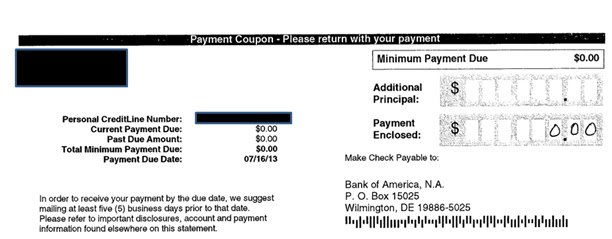
Most of the time, whenever I overdraw on my checking account, I replenish it within hours if not days and bring it back to a zero balance.  Nonetheless, when any transaction occurs, I get a statement like the one shown below in Figure 1 with a zero balance and payment due of zero.  I also get a coupon showing a minimum payment due of—you guessed it—zero.

Figure 1.
After attempting to go paperless using the relevant features on the B of A on-line banking portal and calling them numerous times to ask for this to be set up as a paperless transaction, alas I must admit defeat.  There’s nothing they can apparently do to prevent me from receiving these economically and ecologically wasteful monthly statements—each time arriving with a zero balance.  I actually once sent them a check for $0.00 and signed it—seriously, and to see if might help.  I don’t think B of A caught on to my frustration or my sense of humor.  I wonder whether this is endemic to only large bureaucratic organizations where it is often impossible to connect with a live human being to discuss customer issues in a logical common sense manner.  I can’t be the only B of A customer experiencing this.
For those of you working within large B2C organizations like B of A, does any of this begin to ring true? 
·         What channels of customer issue resolution do you have set up and offer your customers? 
·         Do they experience human avoidance by going though the looping phone tree that deposits you (pun intended in this case) right back where you started? 
·         Do your processes defy logic and common sense? 
·         Do you design your internal systems and processes around employee efficiency, organizational convenience, and workflow over customer expectations and ease of doing business?  
·         How does what I describe here help or hinder customer loyalty and customer advocacy? 
I’d like to hear similar stories from those of you either in B2C or B2B organizations where issues like this seem to go un-resolvable for years.  Just in case you might be wondering, I am not about to close my account with B of A and go elsewhere.  The rest of the experience I have with them is generally good, so this isn’t what I’d consider a show-stopper.  It would probably behoove B of A to save the costs of invoicing me and countless other customers for essentially nothing—not to mention the saving of few more precious trees in the process. 

Monday, June 17, 2013

Quality and Consistency Wins Business and Drives Revenues

I like pizza.  I think I’m among a majority of people who do.  And, pizza I would say is as much a commodity as coffee—although people certainly have their preferences and favorites for sure.  While I’m not here to debate the nutritional merits of pizza, I will admit that I have this craving I must satisfy every couple of weeks.  Therefore, pizza has been a regular element of my diet.  I don’t share this very readily or very often with my nutritionist.  I figure as long as I also consume my requisite daily intake of fruits, vegetables, and whole grains, I’m in good accord.  Besides, pizza crust could be whole-grain, tomato is a fruit, and I’ll often have a veggie pizza.  So, in essence, pizza may be my best nutritional choice, every day…!!  But, I digress.
I’ll use my love of pizza to make a point about quality, consistency and the customer experience and tie that experience directly into business outcomes.  I live in the Boston area where, in the southeastern part of the state at least, “bar pizza” seems to have been born many years ago and still thrives.  Some call it Greek style pizza but it’s those small round ten-inch thin crust versions where there is no discernible crust roll around the perimeter.  Most of the time, these are only available at local taverns or, as they call them here in the Boston area, “baahs.” 
The closest “baah” pizza to me is located in Quincy, MA where I live and is about 10 minutes from my home. Let’s call this Pizza Bar A.  I was fairly attached to Pizza Bar A for about seven years straight—typically getting my pizza a couple of times a month as take-out, since it was so close to home.  Then I began to experience differences (and a degradation) in quality that depended perhaps on who was cooking that night, how busy they were, and what ingredients they were using, etc.  You really have to work hard to make pizza not enjoyable, but somehow they were mastering the art. Once it got to the point where pizza from Pizza Bar A was only enjoyable half of the time, my wife and I decided to look around.   
Our alternative source was found in a town about 45 minutes from my home.  Let’s call this one Pizza Bar B.  So, rather than going there for take-out and arriving home with a cold pizza needing to be reheated, we decided we would just eat-in.  Naturally, eating-in leads to ordering appetizers, drinks, and dessert.  Think up-sell.  Over time, for about a year now, we are finding that Pizza Bar B offers quality pizza that matches Pizza Bar A at its very best and, but more importantly, a consistent product that is unmatched, even though it cost a lot more.  Plus, the service is fast, efficient and just as consistent as the product.  They earn a 10 on the 0 through 10 rating scale from both of us for both quality and consistent products and quality and consistent services.
Now, let’s analyze the simple economics of this situation to see who wins in the long run.    The cost of a pizza at Pizza Bar A is $8 per unit while cost of pizza at Pizza Bar B for the same kind of pizza with the same toppings is $12 per unit, regardless as to whether this is take-out or eat-in.  Because we are eating in at Pizza Bar B, we are also spending a lot more because we are also purchasing beverages and appetizers.
Source
Visits / Year
Spend / Visit
Yearly Spend
Pizza Bar A
24
$18
$432
Pizza Bar B
24
$40
$960


Let’s also add the travel and time component to this analysis as well.  Pizza Bar B is 24 miles away whereas Pizza Bar A is only 6 miles away.  That difference of 18 miles is costing me an extra two gallons of fuel [at $3.50/ gallon] which is adding another $168 to my annual spend just getting there and home.  I’ll not include the cost of my personal time other than to mention that this would be a factor when you extrapolate this to any normal business situation. 
So there you have it.  The bottom line is this.  I will pay over 2.5 times more each year for a quality and consistent pizza experience—satisfying my desire for good pizza—value is king.   And I’m just one customer.  Pizza Bar B has a fairly large capacity and has been in business since 1955.  I’m now a promoter of Pizza Bar B and I highly recommend them to all of my friends and colleagues—even the ones that, like me, that were dedicated to Pizza Bar A.  So, imagine that some of them, let’s say a dozen of them, defect and start going to Pizza Bar B.  That means that Pizza Bar A could be losing somewhere in the vicinity of $15,000 in annual revenues just based on my experience and defection plus that of a dozen friends of mine to which I have spread the word.
Consider the very business you are in—whether B2B orB2C.  How consistent is your product, your delivery, your service and support, your service recovery, and your overall customer experience?  Are you even measuring those touch-points on a regular and consistent basis?  Is quality and consistency part of your organization’s experience design thinking?   How committed is your organization to quality and consistency at every customer interaction?  These are questions worth considering for any business and from a systems perspective, especially as they relate to organizational profitability, business continuity and sustainment, and future growth.

Friday, August 3, 2012

Does Having a Net Promoter Score Really Net You Anything?


It seems that NPS or Net Promoter Score is a very popular customer metric to have and to brag about these days, but what does is really mean or what does it tell you that are both useful and action-oriented?  First of all, it's a metric, and a calculated metric at that.  As a metric it's also simply a number.  Today's temperature is a number.  The Dow Jones daily average is a number.  The latest Olympic achievement involves a number.  We're surrounded by numbers and, in that regard, NPS is in good company.

Let’s dissect NPS a bit more.  As I said, it’s calculated metric.  It’s derived by subtracting Detractors from Promoters.  First you need to survey a bunch of people—how many?  That depends, and that will result in how accurate or how close your mean NPS calculation is to reality.  Let’s pick 500 as the number of people we want to survey.  Now we ask these 500 people this one question, “How likely are you to recommend X to a friend” where X is whatever it is that you are evaluating.  It could be a product or a service or an organization or whatever you want.  Let’s assume 500 people answer you survey and this one question and they respond using a scale of 0 through 10—the standard scale by which NPS is measured—where a 0 indicates an extremely low likelihood to recommend and a 10 indicates an extremely high likelihood to recommend.  After you collect all of the survey responses to this one question you tally up the results and express them as a percentage.  The percentage of those that responded with a 9 or a 10 rating would be added together and called Promoters.  The percentage of those that responded with a 0 through 6 rating would be added together and called Detractors.  Those that were neither Promoters nor Detractors would be those that responded with a 7 or 8 rating and together those are called Passives.  Passives do not factor into the NPS calculation. Then the NPS calculation below would be made.

% Promoters - % Detractors = % NPS

Let’s say that of the 500 people that were surveyed 250 of them were Promoters and 125 of them were Detractors.  That is 50% Promoters minus 25% Detractors giving us a 25% NPS.  Is 25% NPS a good, bad, or indifferent score?  There’s the first real issue with NPS.  We instinctively want to compare it to others.  If someone else tells you their NPS is 50%, are they saying they are twice as good as you?  Not necessarily.  What about 25% being Detractors?  Is that a good, bad, or indifferent score?  There’s the next issue with NPS.  You don’t really know.  If two organizations were to measure NPS and they both found they each had a 25% NPS are they equivalent?  There’s a third issue with NPS.  The same NPS between organizations can be as different as night and day.  Why?  NPS is a calculated metric.   

Let’s assume Organization-A had 375 Promoters out of 500 and 50 Detractors.  That would give them 75% Promoters minus 10% Detractors or an NPS of 65%.  Organization-B has 325 Promoters and 0 Detractors.  That would give them 65% Promoters minus 0% Detractors or an NPS of 65%, the same as Organization A.  Are they equivalent?  My sense tells me that Organization-B is in a better position than Organization-A, because they have no detractors at all.  Organization-B may not have as many promoters but their improvement strategy is clear.  Help improve those (Passives) that don’t have a strong conviction about recommending them to others. So the same NPS between organizations isn’t necessarily equivalent.  Comparing NPS between organizations is risky at best.  Having a lower Detractor level is a better situation no matter what and in that respect; the Detractor level is more revealing than NPS.

Now, let’s go back to the question of whether a 25% NPS is a good, bad, or indifferent score.  In some instances and within some organizations this could be a fantastic score while in some others it could be viewed as abysmal score.  Why is that?  Well, let’s say you started measuring NPS three years ago and it started at 10%.  Assume in year two that it increased to 18% and in year three it hit 25%.  That’s fantastic progress—assuming you knew what it took to drive customers to be more likely to recommend you—more on that in a minute.  Now assume that in that same three-year time period you began with a 45% NPS and in year two it dropped to 35% and in year three it hit 25%.  Now that wouldn’t be a very good thing at all but as you can see, just comparing the current year, those two 25% scores in NPS would be nowhere near equivalent to one another.  In the former scenario you are building customer advocacy nicely and in the second scenario you are losing customer advocacy at an alarming rate.  Don’t forget here that NPS is a calculated metric and it’s important in either scenario to know what’s going on behind the calculation with regard to your Detractors and Promoters.

The last thing I want to say here about NPS in this, my first blog on Blogger, is that unless you are collecting additional data along with your “likelihood to recommend” question leading to the NPS calculation, you have nothing on which to base any actions that would serve to drive the customer experience to a higher level.  Let me be even more specific here, you need open-ended data especially in order to drive action.  This can be as simple as having a question that follows the NPS question that asks for the reason behind the rating.  I’m in favor of a different question for Detractors than for Prompters or for Passives.  Here’s what I mean.

Promoter:      Please tell us how we can maintain your high likelihood to recommend us.
Passive:         Please tell us what we can do to increase your likelihood of recommending us.
Detractor:      Please tell us why you provided that rating.

Of course, including additional open-ended questions in your survey will bring you more specific action-oriented data, especially if linked to a rating question.  Here’s an example of that.

Rating Question:                                          How would you rate our billing dispute process? 
[If customer rates 0 through 6] then ask:   How can we improve our billing dispute process?

So for all you NPS fanatics and foes alike, my take is this.  NPS is a useful concept without a doubt.  What you need to do however is understand that, on the surface, it’s just a number and numbers by themselves rarely, if ever, tell you very much about the future, let alone the present. NPS needs to be part of a system for it to be useful.  That system must include more evidence of the customer experience than a mere number will ever reveal.  Data must be action-oriented for any change to happen.  Chance does not easily happen so you have your work cut out for you.